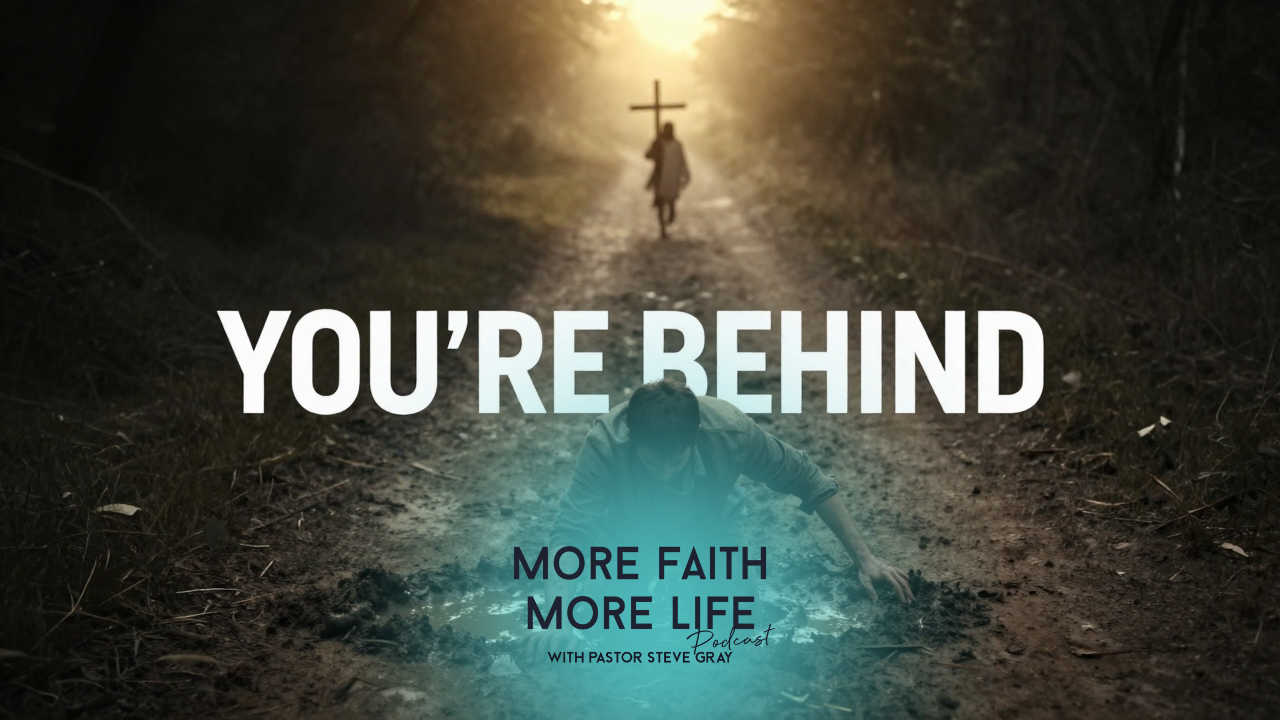
In th is episode of More Faith More Life, Pastor Steve Gray challenges a common belief about the cross and reveals a deeper truth.
What if Jesus didn’t just die instead of you… but died ahead of you?
Through scriptures like Galatians 2:20 and Romans 6, he unpacks what it really means to be crucified with Christ and live a resurrected life. If you’ve felt stuck in your faith, this may be the missing piece.
This isn’t just theology. It’s a call to transformation.
Key Takeaways:
- The episode challenges traditional views, suggesting Jesus’ crucifixion was not merely a substitution but an act of leading believers by example.
- Understanding scripture from the original audience’s perspective can unlock deeper theological insights that propel personal and spiritual growth.
- Pastor Steve emphasizes that identifying with the death of Christ is critical for living fully in His resurrection power.
- This discussion proposes that genuine discipleship involves picking up one’s cross and following Jesus daily in selfless living.
- The potential for personal and collective revival lies in embracing the true essence of being “crucified with Christ.”
Where To Dive In:
00:00 Unlocking New Levels of Faith and Understanding Biblical Roots
04:27 Exploring Theological Interpretations of Jesus’ Crucifixion and Resurrection
11:37 Theological Implications of Substitution in Faith and Participation
14:16 Understanding Sacrifice and Sin in Jewish and Christian Contexts
15:15 Understanding Christ’s Death as Unity with Humanity
18:03 Rethinking Jesus’ Death as a Pathway Rather Than a Substitute
26:20 Potential to Uncover a Missing Link
26:51 Living Through Christ for a Spirit-Filled Life
27:22 Reviving Christianity Through Genuine Transformation and Sacrifice
About the host:
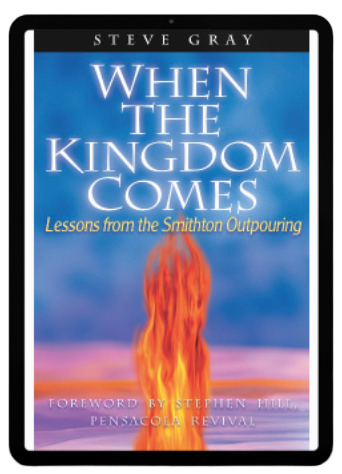
Steve Gray is the founding and senior pastor of Revive Church KC. He has been in the full time ministry for over 40 years and was launched into national and international recognition in the late 1990’s as the leader of the historic Smithton Outpouring, and again in 2009 when he lead the Kansas City Revival which was televised nationally on the Daystar television network. Steve is also a veteran musician, songwriter, recording artist and published author. His books include When The Kingdom Comes, Follow The Fire, My Absurd Religion, and If You Only Knew.
FREE Listener Community
- Weekly spiritual encouragement
- Edification from like-minded, bold Christians
- Community with young leaders who want MORE from life and their relationship with God
Transcript:
0:00:00 – (Steve Gray): Hey, I know you’ve gone to church and thought, I’d just like to hear something new and fresh that really, you know, moves me forward in God. Well, I. It might upset some of you cause it’s new and fresh, but you’re going to hear some of that stuff on the next More Faith, More Life podcast.
0:00:16 – (Steve Gray): You were made for more than the status quo. I’m Pastor Steve Gray, and this is the More Faith, More Life podcast. This podcast is for Christians with an ambitious heart who want to be more
0:00:28 – (Steve Gray): for their family, do more with their
0:00:30 – (Steve Gray): career, and see more of God’s promises in their life. I’ve spent many years as a worship artist, minister, nonprofit leader, bold truth speaker, and most importantly, father and spouse. When I was in my early 40s, I was craving more. More from God and more from life. I’d done everything I was supposed to do. My life was good, but it wasn’t good enough. So I spent the following years diving into the word of God and searching for the biblical principles that would bring me closer to God and help my purpose and life flourish.
0:01:04 – (Steve Gray): That’s what I want to share with you. In every episode, you’ll get practical tools based on real life experiences that you can put into action to redefine your faith and ultimately your life.
0:01:16 – (Steve Gray): So if you’re ready to do more,
0:01:18 – (Steve Gray): so subscribe to More Faith, More Life and hear an unfiltered biblical truth every week. It’s time to be and experience more.
0:01:28 – (Steve Gray): Hello, everybody. Welcome to another More Faith, More Life podcast. Your voice of revival here. I’m here with Zion today. He’s all dressed up as a Kansas City and we’re going to talk about some things today that are very, very important. And I think, Zion, we’re going to say some things that most people have either not ever heard of or never considered. I’m excited to hear this and I think it will. And I’m going to keep teaching on it, not just here, but in churches and everything, and write about it.
0:01:59 – (Steve Gray): I think this is a key what we’re going to talk about today. And it’s going to take us a few minutes to get there. What we’re going to talk about today is life changing. It’s for people who want to go to, shall we just say, another level. They want to go with people, understand what that means. I think, you know, take it up a notch. Yeah, they want to go up a notch with God and, and they just don’t know how. They don’t know what else they could do.
0:02:22 – (Steve Gray): I know I’ve been in hundreds of churches more than that and Watched people worshiping and praising and even in our church watch people, and they’re giving it all they got, but they’re like, I can’t go any farther. This is all I have. And I’m still not moving upward or forward or running faster with God. You know, what do I need to do? And so I began to search out a little bit about our theology and doctrine. And I thought, is there anything in our theology and doctrines that are keeping us in bondage?
0:02:55 – (Steve Gray): Not on purpose, and the way it’s preached is not preached to keep us in bondage, but because we don’t go to what you see, I do all the time, to our original roots of what was the original audience, the original Jewish audience and then later non Jewish audience that was being taught by Jews for those years. What did they think when they heard certain scriptures? And then what are we preaching when we preach those same scriptures?
0:03:25 – (Steve Gray): All right, so in preparation for this, I went and listened to some, what we call Easter sermons, you know, over the last. Just some and not famous. I didn’t go like the mega church person. And then I’m going to criticize them or something. I just went and I just went here in Kansas City and I saw some churches and. And I went on their calendar and saw, oh, this is their Easter sermon. And this year, last year or whatever, and what did they preach?
0:03:55 – (Steve Gray): Okay, so here’s what I. Here’s my. Mostly the same sermons that were good. And this was my takeaway from it that basically. And we’re going to agree with this until we don’t agree as much, but we’re still going to agree with it. Okay, so they come away. And it does approach a little bit. Some of them did approach it as. With great sorrow, compassion, don’t we feel bad? And their thankfulness was that Jesus suffered and had.
0:04:27 – (Steve Gray): And the pain and took our punishment for us. And we’re so thankful for that. And, you know, he. And he took death for me. Okay, that’s kind of it. And I don’t think if we. If you and I discussed that or argued with it too much, people would probably think we’re heretics because, like, what are you saying? Of course Jesus died for our sins and Jesus died for us on the. On the cross. Okay? So I took that and realized, though, there’s a little bit of a hook in it that’s keeping me or us or people like us backwards away from the power of the cross.
0:05:04 – (Zion Vierra): Right?
0:05:05 – (Steve Gray): Because we’re not putting. Putting it in context. Okay? So when some of the scriptures that people preached on this, when the original audience heard them, what did they think? Of course I’m speculating. I don’t know exactly. But I can read history and read theology and study Jewish. You can study Jewish thought even before Jesus. And before Jesus, the Jewish thought of what it means to be a Jew and what do Jews believe and that those kind of. They filtered through till when Jesus is growing up and he’s going to synagogue or the temple, he’s getting those teachings.
0:05:38 – (Steve Gray): Teachings. Of course, he’s getting a lot from God too, you know, in the spirit of God. But he’s basing a lot of his teaching on him being rooted in Judaism. And he did not oppose Judaism. They think. People think he did and they think Paul did, but there’s no proof of that. What happened was through the years is people began to. Way back then, Jews tried to get non Jewish people to become like Jews.
0:06:06 – (Steve Gray): And Paul was saying, they don’t have to. So the takeaway is to keep peace between the two groups is Jewish people, we’re not going to take your Jewishness away. Be Jewish. Jesus did Jewish, fulfilled the law. And Paul, he come to town, first place he’d go. Synagogue or the temple, first place. And yet people act like he started a new religion. Okay, so what are we talking about here? All right, so here we heard the sermon that we’re so thankful. Poor Jesus.
0:06:34 – (Steve Gray): One of the things we have to remember, it’s the Bible says, though, that Jesus obeyed, seeing the joy that was before him. So, okay, he’s in the Garden of Gethsemane. And it’s scary, you know, and he had to be somewhat, I don’t know, a different kind of fear probably than I would have. Cause he’s not like me totally, because he’s total God. But he’s also total man that’s got the same anticipation of what’s going to happen to me, what’s it going to feel like and how bad. And he actually said, is it possible to take from.
0:07:07 – (Steve Gray): So there’s that anticipation of this is not going to be good. But on the other hand, there’s the other anticipation of what did. We’ll try here. What do we think Jesus was thinking when he’s going to go to the cross, knowing that he’s doing it for the benefit of the world. God so loved the world that he sent his son into the world. But when he’s going to be crucified, what’s his theology? If we can use that term? What’s his doctrine going in his head?
0:07:36 – (Steve Gray): What is going to be accomplished with this okay. So that’s what I want to explore. Okay. So I picked. Yeah, I. I picked this scripture, Galatians 2:20, one of my very, very, very favorite scriptures in the whole Bible. And Paul writes this. I have been crucified with Christ. What’s the word you told me a minute ago before, as. As Christ. Yeah, some people said same thing, though. All right, so if we throw out all our doctrines and theology and things we’ve preached on Easter, the way we describe what’s happening to Jesus and why he’s doing what he’s doing, then, and just take this scripture. Is there anything about that line that you’re saying I don’t understand? Well, now, the theology of it is, how are you crucified with Christ and you’re not on the cross hanging with him. Okay, got it.
0:08:25 – (Steve Gray): But something happened. I have been crucified with Christ. So that means Paul saw himself as crucified. As crucified. Right, Whatever that means. He saw himself as crucified. He was the highest Pharisee, probably in all of Israel, even though he left that behind. But he didn’t leave his brain behind. What he knew, you know? And so when he looks at the cross, he says, I’ve been crucified with him and I no longer live.
0:08:57 – (Steve Gray): What. What does that mean? But Christ lives in me. Okay, we get the Christ lives in with me. But the context of it is Christ lives in with me and I don’t. Is that right? I mean, we don’t like to talk about this. We don’t tear it apart like this. Cause we’re already in different realm, and it’s already just planted in us. But the life I now live in the body, so he still gets his body even though he’s been crucified. I live by faith in the Son of God who loved me and gave Himself for me.
0:09:30 – (Steve Gray): But there’s something wrong about our theology. Jesus. Yeah, okay. We preached on Easter. Jesus gave himself for you, but you’ve been crucified with him, as he’s doing something for you, as he’s doing something for the benefit of Zion. You have been crucified. He did something for you, but what did he do actually, in the long run? What did he think he was doing for you? Interesting question. Yeah, okay. Let’s just stay with it.
0:10:03 – (Zion Vierra): Okay.
0:10:04 – (Steve Gray): Okay. Now we’re jumping up to Romans 6, 4 through 6. We won’t do the whole thing, but with that in mind, I have been. We have been crucified with Christ. Then Paul writes again. We were therefore buried with him. What? First crucified. Now on all the Easter sermons, I never heard one person preach. We’ve been buried with him. It’s all. We’re going to be raised with him, but not buried with him through baptism into death.
0:10:35 – (Steve Gray): These are all things that happened to Jesus. Death, it’s different. It’s not physical like we’re thinking, but still it’s there in order that just as Christ was raised from the dead through the glory of the Father, we may now live a new life. And also then it goes on to say, well, let’s just keep going. For we have been unified with him in a death like His. We will certainly also be united with him in a resurrection like his.
0:11:07 – (Steve Gray): Okay, so if we take all this and put it together now, I go in, it’s Easter. Easter eggs are falling out of the sky from a plane or a helicopter. The Easter bunny’s in the foyer, and. And we’re enjoying Easter. And we get up and we’re thankful, and we all of a sudden, we hear the traditional sermon, let’s be thankful. Let’s worship Jesus. Because Jesus was the substitute for us. He took our punishment, he took our death, and he’s the substitution for us.
0:11:37 – (Steve Gray): Okay, now that’s where we have a problem. None of the stuff we said about we’re thankful and, you know, he did it for us and all that, it doesn’t do it. But there is a little bit of problem if you take it and make a theological theme out of substitution. Okay.
0:11:55 – (Zion Vierra): Yeah.
0:11:55 – (Steve Gray): So if you. If you. I don’t know you. We could take anything like a substitute baseball player or whatever, and the guy’s going to go up and they put a pinch hitter in. Well, if you’re getting ready to bat. Cause I know you play softball if you’re getting ready to bat. And all of a sudden, I’m the coach and I say, sorry, we’re putting in a substitute. Where do you go? You don’t get to play anymore. You go where?
0:12:23 – (Steve Gray): To the bench. And the player then gets to play and hit a home run. Jesus hit a home run for us. Yeah, but you’re not there participating in his activity. You’re not there because now you’ve been. He has become your substitute. All right, so when you put this together, I agree with everything that’s being preached. But mentally, when I begin to approach Jesus and I approach the kingdom and I approach who am I and what can I do? And how am I supposed to walk this out? What am I supposed to do today that makes me move more forward, closer, and More glorifying to God. What can I do?
0:13:05 – (Steve Gray): Well, if I have that in my mind, then I don’t know what to do, because I have been. I have a substitute. Yeah. I have somebody that has stepped in for me. I’ve had. I’m in school. Where’s my teacher? She’s. She’s out. We have a substitute teacher, right? And so I don’t know what to do. And if I am a teacher and I’ve been a teacher in the public school, if I’m not there and they put in a substitute, then I didn’t participate. I can’t say I have been.
0:13:35 – (Steve Gray): I was there in your classroom with you. I have been with you in your classroom. I can’t say that I wasn’t there. I have a substitute. So now we have to try to figure this out. I understand that he died a special kind of death for our benefit, but in his mind and through Jewish thinking up to that time when they had sacrifices, right? They did not like a lamb or whatever sheep was being sacrificed. They did not like we think, see that that lamb is being punished, right? It’s a glorified moment.
0:14:16 – (Steve Gray): It is. It’s for sin. But it wasn’t like they’re being punished for me, poor lamb. You know, if your head wasn’t being bashed in, if they weren’t slitting your throat, they’d be slit in mine, okay? That’s how we think in the Jewish synagogue. That’s not what they were thinking. They had a scapegoat, and they would put the sins and they’d send the goat off, right? And then take their sins away. And here’s Jesus who takes our sins away.
0:14:45 – (Steve Gray): But they weren’t in there thinking, like I thought for years, that I’m so thankful for that sheep that that sheep’s getting his throat slit. And if it weren’t for him, I’d get my throat slit because I deserve death. I’ve sinned. The wages of sin is death. And that. All right, so now when we have Jesus dying on the cross, let’s do it just as easy as we can, okay? Let’s think that he’s not thinking of a substitute death.
0:15:15 – (Steve Gray): In other words, he’s dying so I don’t have to. Which I get it. I get it. But it’s more of a case where he’s. He’s taking death on so he can become like we are, cause the wages of sin, of death. So we’re all going to die, okay? But he’s going to go to the cross and take it like that. And it’s not seeing so much as a punishment, but as joining humanity in death. Now he’s going to, but he’s different. Cause he’s going to win the battle over death.
0:15:51 – (Steve Gray): But think of it as his becoming like us in death, okay? Like us. Cause that’s where we were going right? Now take that, that, that’s what he’s thinking. Or that’s the idea theologically. Then like us in his death. Now he never sinned, so he’s not supposed to die, but he’s becoming like us in death. Cause we got death right? Now you take these scriptures and what is it saying now I’m going to take this and I’m going to become death so that you then will become like me in death, so you can be like me in the resurrection. Cause that’s what it says there, right?
0:16:31 – (Steve Gray): We’ll be like him death. So we certainly will also be like him, united with him in the resurrection. Now this might be a little bit of a splitting hairs maybe they say, you know, but really if you think about it theologically and you don’t get all rising up and heretic and they’re, you know, you just think, okay, I’m trying to get people to be able forward. I’m not trying to take anything away. But if you take that, that like him in his death, then all of a sudden you’re like him in his resurrection.
0:17:01 – (Steve Gray): Now just be logical for a moment. If we make him a substitute of our death, then how are we not a substitute? Is he not our substitute in the resurrection? So I don’t really want him to be in my mind at least I understand what he did. I know he did what I can’t do. But if I think of him as he’s substituting for me for death, then so I don’t have to have death. Then how can I be united with him in a death?
0:17:32 – (Steve Gray): Or how can I be crucified with Christ? I have to rearrange my mind and think, wait a minute, he’s aligning himself with me as humanity, as a person who’s going to die in death and he’s going to defeat death. So yes, so I don’t, I can, but in my walk through walk. Cause I’m not always standing at the cross every week, every day, you know. And by the way, one of the scriptures says I die daily, I am crucified daily.
0:18:03 – (Steve Gray): So that’s. Oh wait, hold it. Is that what’s missing in my life? That I can’t go forward because I see him as a substitute Rather than he made himself like me. Not really. Cause he didn’t sin. But he’s associating himself with humanity. Now I need to associate myself with him in his death so that I walk not as a dying person on a cross, but that I live a death. And so that’s why he says, if you’re going to be my disciple, what do you have to do? You pick up your cross and live like I lived with the mentality that I had that I’m doing this. And so now all of a sudden, we have a great phrase, okay, what if we took out the word substitute? Even though I get it, okay? And I’ve preached it myself.
0:18:56 – (Steve Gray): And we know that Jesus died for us and the benefit of us all. But as you look at the cross and you read all these scriptures, that we probably even had more.
0:19:06 – (Zion Vierra): Yeah, a couple more. Yeah.
0:19:08 – (Steve Gray): It is trustworthy saying, if we died with him, what, we shall also live with him. If you make it a substitute that I don’t die with him, whatever that means in the spirit realm. If I don’t spiritually somehow get this, then how can I then say, but I live with him anyway? I never, you know, I don’t think I’ve died with him. I don’t have that theology. I don’t have that doctrine in me. My church doesn’t teach what it means to die with him, to be crucified with Christ, buried with. I don’t know any of that. All I know is he died for me. He’s my substitute for death so I wouldn’t die. Well, all of a sudden now, how can I then say, but that’s okay, because I believe I live now with him and go, that’s not what it says, though. And these people that are sticklers for scripture need to get this and teach this to us.
0:19:53 – (Steve Gray): It’s a trustworthy saying. We died with Him. Okay, how do I get that? Okay, we will also live with him. Okay. Paul wants to know Christ and the power of his resurrection. Me too. And participate in his sufferings. Okay? Get it. Becoming like him in his death. Remember, when he’s on the cross, he’s becoming like me. Now Paul is saying, the guy who wrote all the great things about faith and justification and grace of God says, I want to become so that I can become like him in his death. Well, obviously not. I don’t want to be on a cross. I don’t need to be on a cross because he did that already for my benefit and your benefit.
0:20:35 – (Steve Gray): But have I crossed over to where I’m leading that life spiritually. The exchange, I have lost my life. As it said, I crucified. I no longer live. But I do live by the faith in the Son of God who loved me. So I’m living, but I no longer live. But Christ now lives in me. I’ve made an exchange. It’s not a substitution. He didn’t do it. It’s that I’m aligning myself now with what he did as part of my life. That now I do in a different way.
0:21:08 – (Steve Gray): But I move forward in this because I’m realizing that’s what’s missing. I don’t live my Christian life trying to die to anything. I feed myself, I think of myself, I fight for myself. But Paul apparently was able to say, but I’ve become like him, who didn’t fight for himself, who didn’t think of himself. So I dying to myself pushes me into what Christ was doing. So what I want us to do this phrase. So here’s Jesus on the cross, and we get taught well. He substitutes so I don’t have to die.
0:21:44 – (Steve Gray): And yet all these scriptures says, yes, you do. A different kind, but there is a death. Okay? And we can do the phrase, though, okay? Instead of saying Jesus is the substitute, substitute for me and died instead of me now change your theology and said, no, he died ahead of me, just ahead of me. Because I need to experience on a spiritual level, dying to myself. I need to be buried with him in my mind.
0:22:15 – (Steve Gray): My life is buried, but my life has been resurrected. Yeah, there’s the physical resurrection, but I live the resurrection. I’ve come alive now. I’m living now because I’ve taken on the death of him in myself to live the same sacrifices, the same mentality. Living for other people, living for God, of course, and living to help other people. Living to shine like the light in the world. I’m not living a selfish life just for myself, just hoping that I go to heaven when I die and everybody leave me alone. I’m loved by God just the way I am. I don’t need to change. If you think I need to change, then you don’t love me.
0:22:51 – (Steve Gray): All this kind of rot that goes on in our lives. And so there we see. And then we say, well, I don’t have to die because he died for me. Well, that’s the substitute. But if I said, wait a minute, no, he died not instead of you. He died ahead of you because you’re next in a different kind. You’re in a different kind of way. But see how it Changes your mentality. Like, now I know where I need to go. I know what I need. I need to get this theology in me.
0:23:17 – (Steve Gray): It’s not the whole Bible. It’s not everything about the blessings of God and all that stuff. But it is a big, big portion of scripture that Paul said he did. And if he did it, which we let him lead us in everything else, is it possible that Jesus could have been thinking, I’m not up here instead, like a guy, but I’m up here ahead of them. Cause I’m so thankful I’m looking at these people down there that actually they didn’t crucify him very high.
0:23:45 – (Steve Gray): He was really just at eye level. Rome wanted him to see how terrible it was. But I’m seeing these people that are crying for me and love me and that’s right. I mean, it was probably very painful for them to watch until actually died. But I’m seeing, but I’m not thinking. I’m going instead of you, and aren’t you thankful? But I’m looking said, I’m doing this for you because you’re going to go ahead now after me. I’m going ahead of you and after me, you’re going to take the message of the cross to the world. And the message of the cross is not that Jesus died.
0:24:19 – (Steve Gray): My sermon should be, I have been crucified too. Something in me died of me so that something of him could live in me. Make sense.
0:24:29 – (Zion Vierra): Yeah.
0:24:30 – (Steve Gray): So instead of. Instead of saying he went instead of me, I like to think of it, he went ahead of me and opened the way. And this is where I think we can graduate to another level if we can get off of it, that Pastor Steve Gray’s a heretic and he’s not preaching substitution death. But all these scriptures give us. It’s not a substitute the way we teach it. I get it. We’re not going to the cross. I get it. And it was for our benefit. But the benefit is that I’m going to follow in his footsteps. I’m going to pick up my cross and follow him. I’m going to die daily to myself, and I’m going to become a disciple of his.
0:25:10 – (Steve Gray): I’m going to live that death so I can also live that life. I’m going to be buried with him. I’m going to be united with him so I can be resurrected with him. So it’s all now it’s really in a bigger way all him than it was before when we saw. It’s all him dying in my place is good. I get it. But him dying Ahead of me so I can take his place is a whole different theology. And I think that’s where the church needs to graduate to. We need some great, we need great teaching on this and we need to have this taught on Easter Sunday, the whole story.
0:25:48 – (Zion Vierra): Yeah.
0:25:49 – (Steve Gray): And we rejoice because he died for us. But if you say he died ahead of me because now I have a, I, I need to live this out on that level. Crucified with Christ, buried with Christ, raised with Christ so I can live with all these things. So it’s really. I know you’re. Zion’s got a great mind, he’s a good thinker, you know, he’s a smart guy. And I say now you can let your wheels just start turning on this, turning on this and, and if you work on it for a couple of years, you’ll be able to write a book on it or something.
0:26:20 – (Zion Vierra): How far can you take it?
0:26:21 – (Steve Gray): Yeah, because I think this is the, if we have a missing link, this is the missing link. We’re not saying we were buried with him through his death. We don’t see ourselves as I have died with Christ and I no longer live, but Christ lives in me. And if we could get there, I think we can really change the world. We could change, our worship would change, our influence would change. Our lives would be such a light, such a force to them, such a spirit filled life.
0:26:51 – (Steve Gray): Because I’m not in the way and I’m not trying to live my selfish life and thankful that he took the pain, said no, he did take the pain, but so I don’t live a selfish life that now I live through him. He lived through me, died on the cross for me and you, but so that I could live through him, not instead of Christ, but ahead. He lived, he went ahead of me. So that’s my teaching. It’s not too heretic, is it?
0:27:21 – (Zion Vierra): We’ll get some fun comments.
0:27:22 – (Steve Gray): I’m sure all we’re asking is look at these scriptures and say if I don’t get it all right, there’s a lot of right here to get to
0:27:30 – (Zion Vierra): say maybe there’s plenty to chew on.
0:27:33 – (Steve Gray): Yes, maybe this is the level where the church stays nominal, worldly, carnal, and some people don’t want to be that. I remember when I first preached, you know what, the church is full. They said to me, yeah, but you know, the church is full of hypocrites. And I said, yeah, you’re right. And they didn’t expect me to say, you’re right. I know I should know. I know better than you, probably the reporter. The church is full of hypocrites. Yeah, that’s right. But now we can change that.
0:27:58 – (Steve Gray): Right? They’re full of hypocrites. And then I said to them, but one thing you don’t realize, the church is full of hypocrites. It’s also full of hypocrites who don’t want to be hypocrites.
0:28:08 – (Zion Vierra): Yeah, right.
0:28:09 – (Steve Gray): They don’t want. They’re not doing it on. Some people do it on purpose, but most people don’t. Most people are locked into something they can’t get out of. And I think if we can say let’s look to being to die with him, crucified with Christ, buried with him, raised with him to the newness of life so that we can shine like a light into the world and share in the resurrection power. And sometimes we’ll share any sufferings. Sure.
0:28:33 – (Zion Vierra): Yeah.
0:28:33 – (Steve Gray): Because I think it’s expected to. Yeah, we’re going to share any sufferings by laying down our lives. When we’d like to pick up a
0:28:41 – (Zion Vierra): death isn’t necessarily like a happy joyful thing.
0:28:43 – (Steve Gray): No, there’s things. Yeah, I mean we’d like to pick up a stick and hit people.
0:28:46 – (Zion Vierra): Yeah.
0:28:47 – (Steve Gray): Whip people with it.
0:28:48 – (Steve Gray): Sure.
0:28:48 – (Steve Gray): But instead I’m going to lay down my life and they may with me. So anyway, I hope this was good in this season and I hope it gives everybody something to think about. And it’s not. I don’t want to take away from anything, but I think this is a great revelation of maybe what’s next steps towards possibly a revival in America. If this, if we became alive this way, not in ourselves, but as crucified with Christ, it might spark a new level of Christianity here and around. Yeah, here and around the world. So anyway, be sure and go to https://stevegrayministries.com if you want to learn more.
0:29:24 – (Steve Gray): This is the first time I’ve ever talked about this, so it won’t be on there yet. Things like this are everywhere on there. Tell your friends about it. And if you got really upset about something I said, tell your friends about that too. Cause then they’ll listen to this and then they’ll straighten you out.
0:29:42 – (Zion Vierra): We’ll read all your mean emails, I promise.
0:29:46 – (Steve Gray): No, I think there’s too much here to get too angry because I’m not trying to take away. I’m trying to add to a better life. Yeah. And so anyway, so we’re so glad that you could be a part of this. We pray for revival in America These are just a voice of revival. What can we do to bring us closer to God? To have a revival in America and get a real salvation movement across from east coast to the West coast, north and South.
0:30:12 – (Steve Gray): Right? Till next time, Bye-bye.



Leave A Comment
You must be logged in to post a comment.